
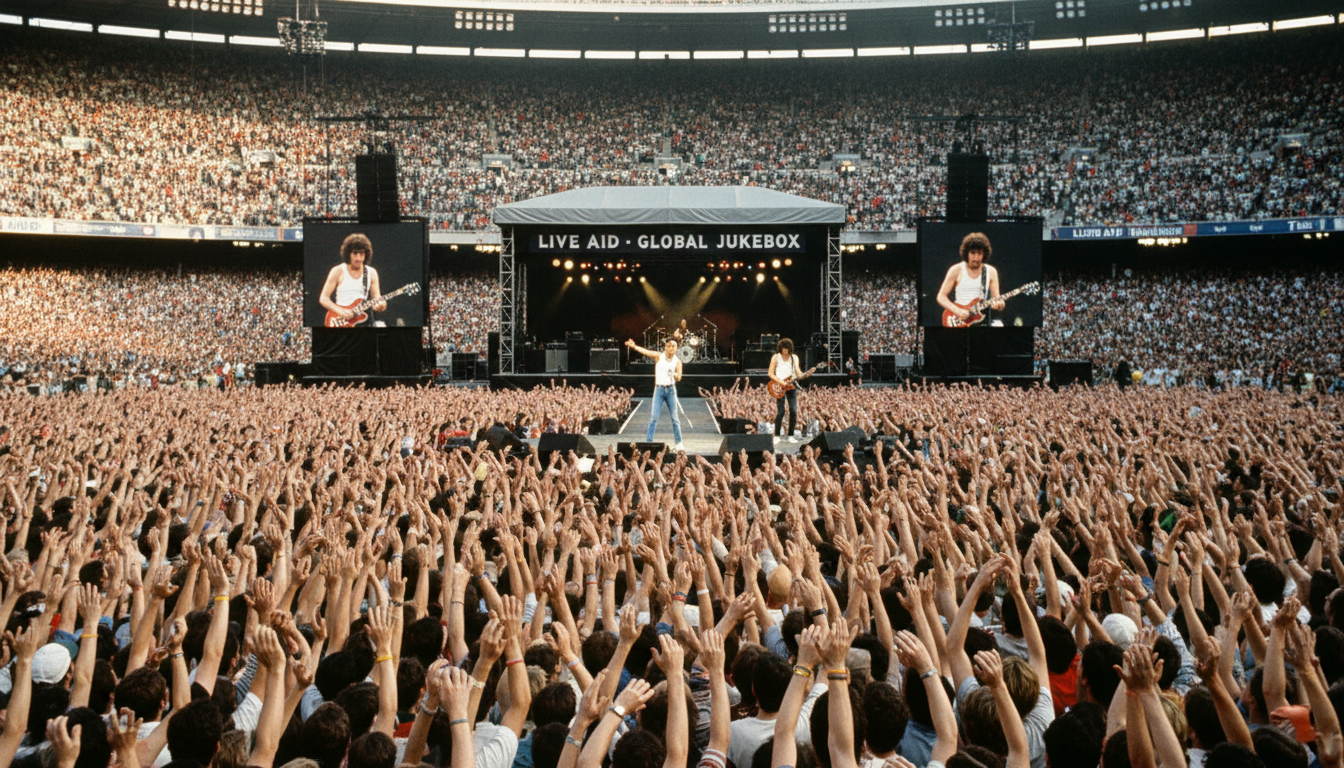

The long-term legacy of Live Aid is undeniably profound: it raised tens of millions for famine relief, inspired future humanitarian concerts, reshaped how media and activism intersect, and remains both celebrated and critiqued. Yet, revisiting it after the 40th anniversary reveals a multifaceted impact—one rooted in cultural unity and noble intent, but complicated by evolving perspectives on narrative representation and effectiveness.
Remaking Memory: The Anniversary and Its Modern Echoes
The 40th anniversary of Live Aid in 2025 catalyzed a wave of retrospectives—and the legacy conversation continues to reverberate. The London musical Just for One Day recaptures the events leading to the benefit concert, blending music, drama, and memory. Midge Ure, reflecting on the production, said, “We created a monster… And it had to happen,” arguing that Live Aid’s scale and spontaneity were products of an era now transformed by fragmented media and fleeting attention spans .
Meanwhile, the full 16-hour original broadcast was made available for streaming, allowing audiences to relive the event in its raw, sprawling form . Bono joined in with humorous humility, lamenting his 1985 mullet in a new documentary: “One of the most famous moments of your life and your activism… you’ve got a mullet,” underscoring how even iconic figures carry eighteen-year‑old embarrassment .
Financial and Cultural Aftershocks
The inflation-adjusted financial impact of Live Aid remains impressive. Estimates put the raised funds at around $125–127 million at the time, equivalent to several hundred million dollars today . It was pivotal in mobilizing surplus grain shipments to Ethiopia and spotlighting famine in mainstream Western policy dialogues .
But it wasn’t just about money. The event became a blueprint for benefit concerts worldwide—from Live 8 to Farm Aid—and shifted how media and celebrities could coalesce in service of humanitarian causes .
Critical Unearthing: Narratives Under Scrutiny
With the benefit came critiques, some asserting that Live Aid perpetuated a simplistic “save Africa” narrative. This narrative, critics argue, flattened complex issues into missionary tropes, reinforcing harmful stereotypes even as millions were helped . A Guardian op‑ed warned that reviving Live Aid through a musical risks resurrecting its problematic tropes for a new generation .
Bob Geldof and Midge Ure defended their intentions—emphasizing urgency, frugality, and impact—but acknowledged that the cultural context of 1985 can’t be replicated today. Ure mused that smartphones and splintered attention spans would make such a unifying moment impossible now .
Behind the Scenes: Innovation and Stagecraft
What made Live Aid extraordinary wasn’t just its star-studded lineup—it was the logistical genius behind it. Bill Graham, lead organizer for Philadelphia, engineered a backline on a rotating turntable, ensuring smooth and rapid transitions between acts. His son described it as a “logistical crowning achievement” .
And of course, Queen’s legendary 21-minute set, opening with Bohemian Rhapsody and culminating in “We Will Rock You” and “We Are the Champions,” became a defining moment in rock history. In 2005, their set was voted the best rock gig of all time .
A Tension of Memory: What We Celebrate and What We Question
The divergent reactions to Live Aid’s legacy speak to a broader tension between celebration and critique. For many, it remains a symbol of music’s power to unify and mobilize compassion. For others, it is a cautionary tale—well-meaning, but wrapped in problematic representation.
The musical Just for One Day reflects that tension: a heartfelt tribute with 10% of proceeds going to the Band Aid Charitable Trust, which still operates with zero overhead and volunteer trusteeship, committed to effectiveness .
Concluding Summary
Live Aid’s legacy is a complex tapestry of monumental triumphs and unresolved tensions. The 40th anniversary reignited both fond remembrance and critical reflection. As we revisit its echoes through musicals, documentaries, and streaming broadcasts, the event stands as both a high watermark of global solidarity and a window into how our narratives must evolve. Live Aid reminds us that big gestures can move mountains—and that how we tell those stories deserves the same urgency as the causes themselves.
FAQs
What was the financial impact of Live Aid originally?
Live Aid raised over $125 million at the time, which would translate to several hundred million in today’s dollars. It helped alleviate famine in Ethiopia and influenced policy shifts in Western countries.
Why do some critics view Live Aid negatively?
Critics argue that Live Aid perpetuated a “white saviour” narrative and over-simplified Africa’s issues, creating a one-dimensional image of a complex continent.
What is Just for One Day and how does it relate?
Just for One Day is a jukebox musical that dramatizes the origins and impact of Live Aid, transferring to London’s West End in May 2025 and giving 10% of its proceeds to Band Aid’s charitable trust.
Could an event like Live Aid happen today?
Co-founders argue it couldn’t. Midge Ure says the fragmented media landscape and shortened attention spans make such unified mass engagement nearly impossible now.
What technical innovations made Live Aid possible?
Bill Graham pioneered a rotating turntable stage setup that enabled seamless transitions between performances—an engineering marvel at the time.
Which performance is considered Live Aid’s most iconic?
Queen’s Wembley set, particularly their rendition of Bohemian Rhapsody, is often described as the greatest rock performance ever. It continues to be celebrated decades later.







Leave a comment