
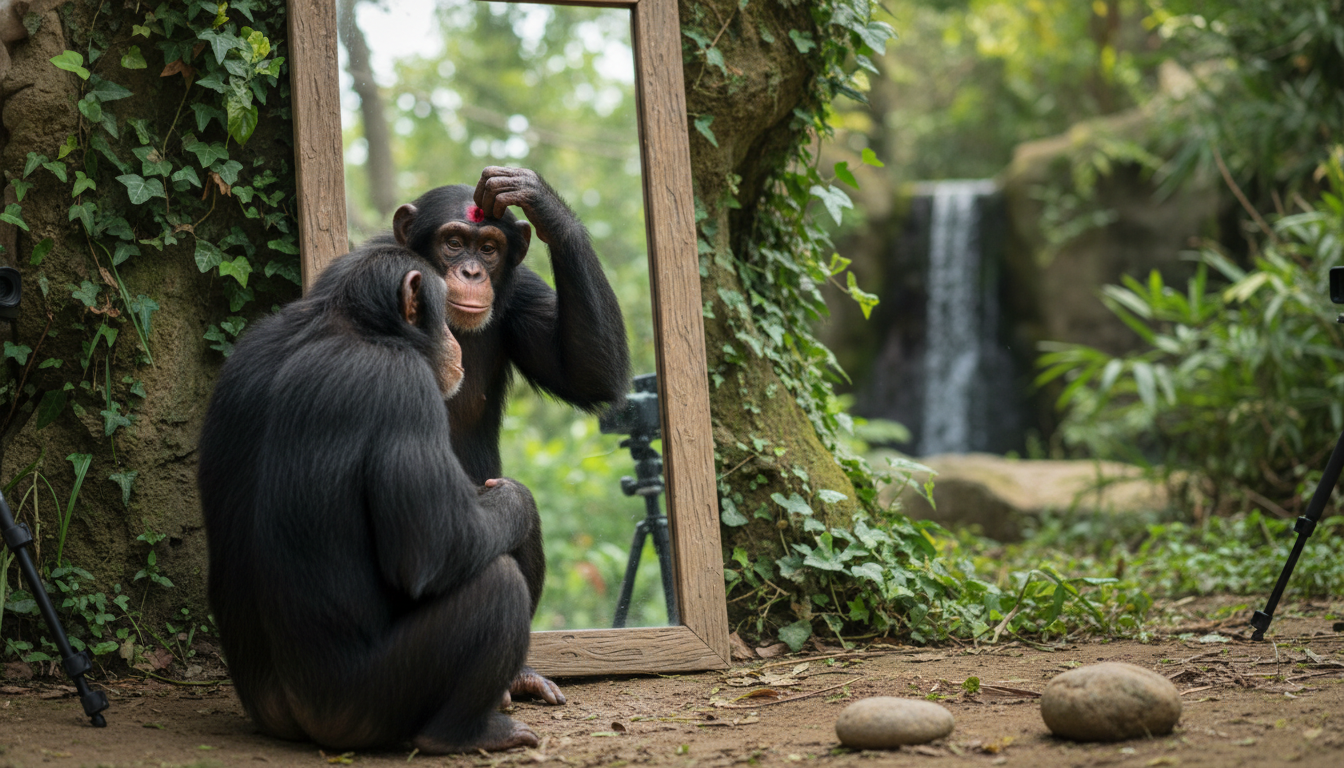

Mirror-testing—the so-called Mirror Self-Recognition (MSR) or mark test—serves as one of the most intriguing and controversial gateways into understanding whether animals possess a sense of self. Developed in 1970 by psychologist Gordon Gallup Jr., this behavioral experiment involves subtly marking an animal (often with dye) in a spot they can’t normally see, then giving it access to a mirror to see if it inspects or touches the mark—suggesting awareness of the reflected image as their own . Over time, this procedure has sparked debates, prompted refinements, and expanded our thinking about consciousness beyond human boundaries.
(admittedly, sometimes I think how odd it is we equate self-awareness with touching an eyebrow you can’t see—but still, the mirror test remains a cultural touchstone in science.)
Why Mirror-Testing Matters (and Why It’s So Tricky)
Mirror-testing has historically been considered a strong tool for detecting self-recognition, yet its limitations remind us that consciousness can’t be reduced to simple behaviors.
The Strength of Visual Self-Recognition
Primates, as well as several other intelligent species, have often passed MSR, giving weight to the test’s value:
– Chimpanzees, bonobos, and orangutans frequently touch the mark after seeing themselves in a mirror .
– Bottlenose dolphins also inspect marked areas of their bodies, sometimes twisting to view them in mirrored surfaces .
– Even Asian elephants have passed—one elephant named “Happy” repeatedly touched a painted mark on her head only after seeing it in a mirror .
The Challenge of Sensory and Motivational Biases
On the flip side, MSR isn’t universal—and failures don’t necessarily indicate a lack of self-awareness:
– Dogs may fail because they rely more on scent than vision, not because they lack a sense of self .
– Elephants may simply not care enough about a surrogate mark to react—even though they may understand their reflection as self .
“Self-awareness is not binary, and the mirror test should not be relied upon as a sole indicator,” observes primatologist Frans de Waal, underscoring that cognition is nuanced .
Who Has Passed the Mirror Test—and What It Means
A surprising variety of species have shown mark-directed behaviors. Let’s explore some notable examples:
Great Apes and Mammals
- Great Apes: Chimpanzees, orangutans, and bonobos reliably show mirror self-recognition; gorillas are more inconsistent, sometimes inhibited by social dynamics .
- Dolphins and Orcas: Known for cetacean intelligence, these marine mammals often show clear MSR behaviors .
- Asian Elephants: At least one elephant in controlled studies has touched a painted mark only visible in a mirror .
- Mice: A 2024 study in Neuron suggests mice can recognize and respond to body smudges viewed in mirror reflections .
Birds, Fish, and Invertebrates
- Eurasian Magpie: First non-mammal to pass MSR—when marked on the throat, they scratch the area while viewing themselves in a mirror .
- Cleaner Wrasse (Fish): These fish scrape marks off their bodies after seeing them in mirrors; some scientists argue whether it’s self-awareness or an ecologically primed response .
- Manta Rays and Ghost Crabs: Manta rays have shown mirror contingency-checking behaviors, and ghost crabs have also passed with rudimentary self-awareness in recent studies .
- Ants (Myrmica spp.): Certain ant species attempted to remove paint after seeing themselves in a mirror .
The Expanding Spectrum of Self-Recognition
It’s eye-opening to think that everything from fish to rodents to insects could possess fragments of self-awareness. But it also reveals how the mirror test might capture different forms of cognition that aren’t directly comparable across species.
Beyond the Mirror: Alternative and Supplemental Tests
Relying solely on MSR means some forms of awareness go under the radar.
Olfactory Self-Recognition
- Wolves: Show self-awareness using scent-based tests—recognizing their own odor vs. others—in a “sniff test” alternative .
- Dogs: Similarly may fail MSR but could demonstrate self-recognition via fragrance-based paradigms .
Training to Understand Mirrors
- Rhesus Monkeys: Typically fail MSR, yet several have passed when trained to use mirrors as tools—then touching marks on their bodies .
This shows the test may not reflect capability but rather familiarity with the mirror medium itself.
A Continuum, Not a Checklist—Reframing Self-Awareness
Recent discourse emphasizes that self-awareness likely exists along a gradient—rather than as an on/off trait.
- Cleaner wrasse, for instance, might perform mark-directed behaviors without possessing the full sense of self we attribute to primates .
- Cognitive neuroscientist Michael Platt notes that whether mirror behavior reflects “self-awareness” or just “self-referencing” remains open to interpretation .
This more nuanced framing helps us see intelligence not as a binary, but a spectrum of capacities adapted to each species’ ecology and sensorium.
Conclusion: Mirror-Testing as a Window, Not the Full House
Mirror-testing remains a fascinating, informative, but imperfect tool for exploring animal cognition. Its strengths lie in its elegant simplicity and ability to spark deep questions about what it means to recognize oneself. Yet its limitations—sensory biases, lack of motivation, unfamiliarity—highlight the need for complementary approaches and more sensitive interpretations.
Strategically, researchers would benefit from combining MSR with tests tailored to species-specific senses (like olfactory or auditory), along with mirror training when relevant. Only then can we appreciate the rich, diverse inner lives that stretch across the animal kingdom.
FAQs
1. What exactly does passing the mirror test indicate?
Passing the mirror test suggests an ability to recognize one’s reflection as oneself. It’s strong evidence of self-recognition, but not definitive proof of the full psychological trait of self-awareness.
2. Why do some species fail the mirror test?
Failing can reflect lack of motivation, unfamiliarity with mirrors, or reliance on other senses (like smell), rather than absence of self-awareness—so it’s not always telling.
3. Are non-primate animals self-aware?
Some non-primates—dolphins, elephants, magpies, even cleaner wrasse—demonstrate behaviors suggestive of self-recognition. While compelling, this warrants cautious interpretation within each species’ context.
4. Can training animals to use mirrors affect results?
Yes. Species like rhesus monkeys have passed mirror tests only after being trained to use mirrors, suggesting prior failures may stem from unfamiliarity rather than a cognitive deficit.
5. Are there alternatives to mirror testing for assessing self-awareness?
Yes. Researchers explore other modalities like scent-based tests (e.g., wolves sniffing their own odor) and context-appropriate challenges to better match species-specific senses.
6. Does mirror recognition equal consciousness?
Not necessarily. Mirror recognition is one behavioral marker of self-reference. Consciousness spans many dimensions—awareness, agency, emotions—and requires a broader set of measures to understand deeply.







Leave a comment